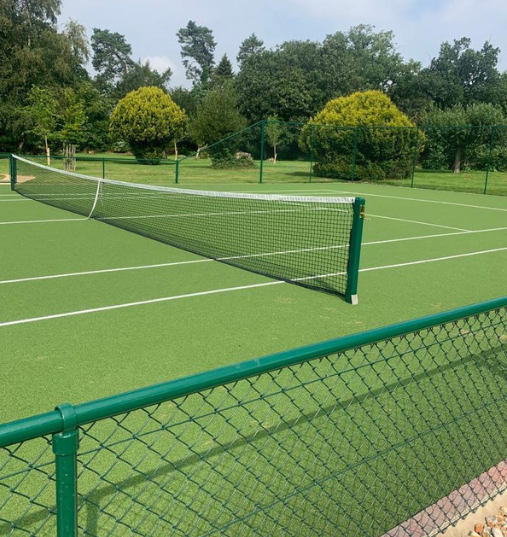
A tennis court can remain an important and highly usable facility for many years, but regular exposure to weather and repeated play will gradually affect its condition. An older court may begin to show surface wear, fading, moss growth, drainage concerns, damaged fencing or other signs that it no longer performs or looks as it once did.
This does not automatically mean that complete reconstruction is necessary. Where the underlying court remains suitable, professional refurbishment can address deterioration, improve playing conditions and restore the overall appearance of the facility.
For tennis courts throughout Wiltshire, UK, Tennis Court Construction Wiltshire provides professional court refurbishment focused on identifying what the existing facility actually requires and carrying out appropriate improvements.
What Does Tennis Court Refurbishment Involve?
Refurbishment is not one single treatment. The work required depends on the existing court, its construction and the type of deterioration that has developed.
A refurbishment project may involve several different elements, such as:
- Thorough surface cleaning
- Removal of moss and organic contamination
- Localised surface repairs
- Crack treatment
- Resurfacing where appropriate
- Repainting and new line markings
- Drainage improvements
- Fencing repairs or replacement
- Net post and associated equipment improvements
The objective is to address the condition of the court as a complete facility rather than simply making it look newer.
1. Refurbishment Can Restore the Playing Surface
The playing surface is naturally one of the most important parts of any tennis court.
Years of use and weather exposure can gradually leave it looking tired and inconsistent. Areas may become worn more heavily than others, while contamination can affect the appearance and feel of the surface.
Professional refurbishment can restore a cleaner and more consistent playing area.
Depending on the existing condition, this may involve cleaning and local repairs or more extensive resurfacing.
The correct approach should always be determined by the condition of the existing construction rather than applying a standard treatment to every older court.
2. Surface Cleaning Can Make a Significant Difference
Some courts appear to require substantial work when a considerable part of the problem is actually accumulated contamination.
Outdoor tennis courts are continually exposed to leaves, dirt and organic matter. Moss and other growth can become established, particularly where moisture remains on sections of the surface.
Professional cleaning can remove this build-up and reveal the underlying condition more clearly.
Cleaning is therefore valuable for two reasons: it can improve the court’s appearance and make it easier to identify areas that genuinely require repair.
3. Refurbishment Can Address Cracks Before They Become More Extensive
Cracks are a common concern on older hard courts.
A small crack should not simply be judged by its width or length. Understanding why it has developed is equally important.
Potential contributing factors can include:
- Movement within supporting layers
- General ageing
- Water-related deterioration
- Previous repairs
- Localised settlement
Treating the visible crack without considering the underlying cause may provide only a temporary improvement.
Professional assessment helps establish whether cracking is isolated or part of a wider pattern across the court.
4. Resurfacing Can Restore a Consistent Finish
Where an existing surface has become extensively worn but the underlying construction remains appropriate, resurfacing may provide a practical way to improve the court.
A renewed playing surface can address widespread deterioration and create a more uniform finish than repeatedly treating numerous isolated worn areas.
Resurfacing can improve:
- Overall appearance
- Surface consistency
- Court definition
- Playing experience
- The presentation of the entire facility
Correct preparation remains essential. Applying a new surface over unresolved underlying defects can allow existing problems to reappear.
5. New Line Markings Can Transform an Older Court
Faded tennis court markings can make even a reasonably serviceable surface look neglected.
Clear, accurately applied markings help restore the professional appearance of the court while making boundaries easier for players to identify.
Line marking is usually most effective as part of a properly planned refurbishment rather than being applied over a dirty or deteriorating surface.
The condition of the court should therefore be addressed first so that the finished markings form part of a complete improvement.
6. Drainage Problems Can Be Investigated
Water that remains on a tennis court for extended periods can interfere with its usability and contribute to surface deterioration.
If puddles repeatedly form in particular locations, simply resurfacing the visible area may not resolve the problem.
The refurbishment process provides an opportunity to investigate factors such as:
- Surface levels
- Existing drainage
- Low points
- Blocked or restricted drainage areas
- Surrounding vegetation and debris
- Localised settlement
The aim is to understand why water is accumulating rather than repeatedly dealing with the symptoms.
7. Fencing Can Be Included in the Refurbishment
A tennis court is more than its playing surface.
Perimeter fencing helps contain tennis balls and defines the playing environment. Over time, fencing can become damaged, distorted or loose.
Older courts may have:
- Damaged mesh
- Loose sections
- Leaning posts
- Deteriorated gates
- Poorly functioning access points
Addressing these problems alongside the surface can create a much more complete refurbishment.
A freshly resurfaced court surrounded by severely deteriorated fencing will still feel unfinished, so considering the complete facility often produces the best result.
8. Net Posts and Court Equipment Can Be Reviewed
Small details can have a surprisingly large effect on how an older tennis court functions.
Net posts and associated equipment should be assessed as part of the wider refurbishment where appropriate.
Equipment that has become worn, damaged or difficult to use can detract from an otherwise improved court.
Reviewing these components while other refurbishment work is taking place provides an opportunity to create a more complete and usable facility.
9. Refurbishment Can Improve the Appearance of the Entire Site
Tennis courts occupy a substantial area, meaning their condition can influence the appearance of the surrounding property or grounds.
Faded surfaces, unclear markings, organic growth and deteriorating fencing can make the whole facility look considerably older.
A professionally refurbished court can create a cleaner, sharper and better-maintained appearance.
This is particularly valuable where the tennis court forms a prominent part of a residential, educational, sporting or other outdoor setting.
10. It Can Make the Court More Enjoyable to Use
The value of refurbishment is not purely visual.
A tennis court exists to be used, and deteriorating conditions can gradually make playing less enjoyable.
Uneven deterioration, contamination and damaged court features can all interfere with the experience of using the facility.
Restoring the surface and addressing other defects can make players more inclined to use the court regularly rather than viewing it as an ageing area that is increasingly difficult to maintain.
Does Every Old Tennis Court Need Resurfacing?
No.
Age alone does not determine what work is required.
One older court might remain structurally suitable and require cleaning, localised repairs and fresh markings. Another may have widespread surface deterioration that makes resurfacing more appropriate.
The important factor is condition.
A professional assessment should establish which parts of the existing court remain serviceable and which require improvement.
When Is Refurbishment Better Than Repeated Small Repairs?
Localised repairs can be perfectly appropriate where deterioration remains confined to individual areas.
However, there comes a point where repeatedly treating new defects may become less effective as an overall maintenance strategy.
A broader refurbishment may deserve consideration when:
- Several areas are deteriorating simultaneously
- Surface wear has become widespread
- Markings are heavily faded
- Cracking appears in multiple locations
- Drainage problems repeatedly affect use
- Fencing and other components also need attention
- The court generally looks and feels tired
Looking at the facility as a whole can help determine whether several individual problems are actually connected by general age and deterioration.
Why the Existing Base Matters
One of the most important parts of tennis court refurbishment is understanding what lies beneath the visible surface.
If the supporting construction is stable and performing appropriately, retaining it may allow the existing court to be refurbished successfully.
If significant movement or deterioration exists underneath, however, surface-level improvements alone may not provide the desired long-term result.
This is why assessment should come before decisions about resurfacing or cosmetic improvements.
Refurbishment Should Be Planned as a Complete Project
A good refurbishment follows a logical sequence.
There is little benefit in applying fresh markings before resolving surface defects, just as installing a new finish over unresolved drainage problems may leave the underlying issue untouched.
A professional approach considers:
- Existing court condition
- Surface defects
- Supporting construction
- Drainage and water movement
- Cleaning requirements
- Repairs or resurfacing
- Fencing and equipment
- Final finishing and markings
Planning the work in the correct order helps ensure each improvement supports the next.
Signs Your Tennis Court May Benefit from Refurbishment
It may be worth arranging an assessment if you have noticed:
- Extensive fading
- Moss or organic growth
- Surface cracking
- Worn playing areas
- Recurring puddles
- Uneven sections
- Poorly defined markings
- Damaged perimeter fencing
- Deteriorating gates
- Several previous repairs across the court
One issue does not necessarily mean extensive refurbishment is required, but several developing together can justify looking at the court more comprehensively.
Professional Tennis Court Refurbishment in Wiltshire
At Tennis Court Construction Wiltshire, we provide professional tennis court construction and refurbishment services throughout Wiltshire, UK.
An older court should not automatically be assumed to need complete reconstruction. By assessing the existing surface, base, drainage, fencing and other important components, it is possible to determine which elements can remain and where improvements are genuinely required.
Whether the court needs targeted repairs, resurfacing or a more comprehensive refurbishment, the objective should be to create a facility that performs well, looks professionally maintained and is enjoyable to use.
Conclusion
Professional refurbishment can significantly improve an older tennis court by addressing surface deterioration, cracking, contamination, faded markings, drainage concerns and ageing perimeter features.
The most important step is identifying what the court actually needs. Some facilities may benefit from relatively focused improvements, while others require resurfacing and wider refurbishment to achieve a consistent result.
For tennis courts throughout Wiltshire, UK, Tennis Court Construction Wiltshire can assess the existing condition and recommend an appropriate refurbishment approach. If your court is becoming worn, difficult to maintain or less enjoyable to use, a professional assessment can help establish how it can be restored and brought back into dependable use.
Call us on: 01722 548994
Click here to find out more about Tennis Court Construction Wiltshire
Click here to complete our contact form and see how we can help with your courts needs.