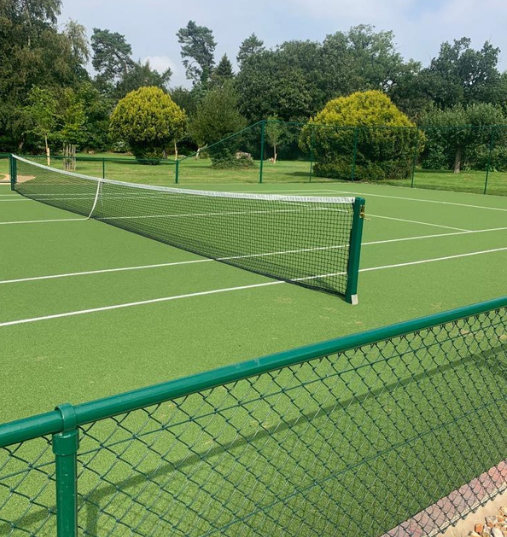
A new tennis court must provide more than an attractive playing surface. It needs to remain stable under repeated use, drain rainwater effectively and deliver a consistent response across the entire playing area. These qualities depend on the construction beneath the surface as much as the visible finish.
Ground preparation, base design, levels, drainage and surface installation all need to work together. For schools, clubs and private properties in Wiltshire, UK, professional tennis court construction helps create a facility that is practical for regular play and manageable over the longer term.
The Essential Features of a Reliable New Tennis Court
A suitable court should provide consistent footing, predictable ball behaviour and dependable access throughout its intended playing season. Achieving this requires careful design and accurate construction at every stage.
A Stable and Well-Compacted Foundation
The foundation supports the complete court and carries the loads created by players, maintenance equipment and surrounding installations. Weak ground or inconsistent compaction can cause settlement, cracking and changes in surface level.
Site preparation may involve removing unsuitable material, stabilising weak areas and installing compacted aggregate layers. The precise construction should reflect the ground conditions and selected playing surface rather than relying on a standard approach for every site.
Accurate Court Levels
A court needs carefully controlled levels to create an even playing area while allowing water to drain. Excessive slopes can affect play, but an insufficient fall may leave standing water after rainfall.
Professional construction uses measured levels across the entire court. This helps prevent low spots, abrupt changes and uneven areas that could interfere with movement or cause premature surface deterioration.
Effective Drainage
Water should leave the playing area efficiently without washing material onto the court or collecting around its edges. Persistent moisture can disrupt play and gradually weaken supporting layers.
An effective drainage design considers:
- The natural fall of the site
- Ground permeability
- Surface type
- Surrounding ground levels
- Water entering from adjacent areas
- Drainage outlets or channels
- Court edges and access points
Drainage must be considered before construction begins because correcting it after the surface has been installed can require disruptive work.
A Surface Suited to the Intended Use
Different tennis court surfaces provide different playing characteristics and maintenance requirements. The appropriate choice depends on how frequently the court will be used, who will play on it and how it will be maintained.
The finished surface should provide:
- Consistent ball bounce
- Reliable grip underfoot
- Even colouring and texture
- Suitable cushioning or firmness
- Clear line visibility
- Compatibility with the supporting base
Correct installation is essential, as even a high-quality material may perform poorly if it is laid unevenly or over an unsuitable foundation.
Consistent Compaction and Surface Finish
Variations in compaction can create sections that behave differently underfoot or settle at different rates. Each construction layer must therefore be installed at the correct depth and compacted consistently.
The final surface should be even across playing and run-off areas. Joints, transitions and perimeter sections require particular care because weaknesses often develop where different materials or construction details meet.
Adequate Run-Off Space
Players need sufficient space around the marked court to move safely and retrieve balls. A technically accurate playing area may still be unsuitable for regular use if the surrounding run-off is too restricted or uneven.
The design should also allow practical access for cleaning and maintenance. Gates, paths and entrances need to be positioned without creating weak or awkward sections along the court perimeter.
Correctly Installed Fencing
Court fencing contains balls and helps protect nearby areas from disruption. It should be secure, correctly tensioned and positioned so it does not interfere with play.
Posts need stable foundations, while gates should open and close without dragging across the court. The lower edge of the fencing should also be finished carefully to avoid gaps that allow balls to escape.
Clear and Accurate Court Markings
Playing lines must be straight, correctly positioned and easy to distinguish from the surrounding surface. Poorly measured or irregular markings can affect gameplay and make the court appear unfinished.
The coating used for the lines should be compatible with the playing surface. It must bond correctly without creating raised, slippery or excessively textured areas.
Suitable Net Posts and Equipment
Net post foundations should be installed accurately during construction so the posts remain aligned and stable. Incorrect positioning can affect net tension and court dimensions.
Removable equipment should fit securely without leaving poorly finished sockets or surface defects. Any additional fixtures should be planned early rather than added after the court is complete.
A Surface That Can Be Maintained Properly
Regular use inevitably introduces dirt, leaves, organic growth and general wear. A well-constructed court should allow these issues to be managed without unnecessary difficulty.
Maintenance commonly includes:
- Removing leaves and loose debris
- Keeping drainage points clear
- Treating organic growth appropriately
- Checking fencing, gates and equipment
- Monitoring cracks or surface movement
- Refreshing worn markings when required
- Addressing isolated defects promptly
Planned maintenance helps preserve playing characteristics and prevents minor problems from spreading.
Time for the Court to Settle or Cure
A newly installed court may need a suitable period before regular play begins. The required time depends on the surface system, weather and materials used.
Using the court too soon can mark the surface or affect coatings before they have developed sufficient strength. The construction team should provide clear guidance on when the facility is ready for play and how it should be treated during its initial period of use.
Professional Quality Checks
Before handover, the court should be checked for surface consistency, drainage, line accuracy and equipment alignment. Gates, fencing and access areas should also operate as intended.
These checks help identify small adjustments before the court enters regular use. They also confirm that the complete facility—not only the central playing surface—has been finished correctly.
Conclusion
A newly constructed tennis court is suitable for regular use when it has a stable foundation, accurate levels, effective drainage and a consistently installed playing surface. Safe run-off areas, secure fencing, correct markings and planned maintenance are equally important.
Tennis Court Construction Wiltshire provides professional tennis court construction throughout Wiltshire, UK. If you are planning a new court, contact the team to arrange an assessment and discuss a design suited to its intended use.
Call us on: 01722 548994
Click here to find out more about Tennis Court Construction Wiltshire
Click here to complete our contact form and see how we can help with your courts needs.